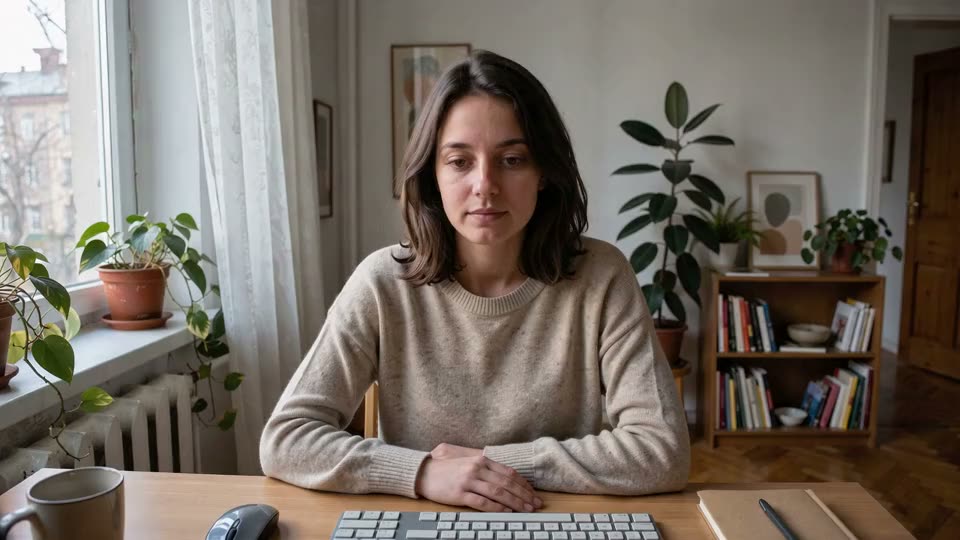
Words, not faces
The AI assesses the transcript only. It never analyses the video, the face or the voice.
Face, voice and body language are never analysed
Their own time.Their best take.
Candidates record video answers with 30 seconds to think and the retakes you allow. You get every video, a transcript and scores with quotes.
14 days free5 interviews includedNo card neededSee pricing
Tell us about your experience.
Sample with an AI-generated candidate, sped up.
A one-way video interview, also called an asynchronous or recorded video interview, is a first-round interview without a live interviewer. The candidate reads each question and records a video answer whenever suits them before a deadline. Your team watches the answers later and compares candidates on the same questions.
Every question works the same way. Click through the four moments, or let them play.
Breaks between questions
Time only runs once they open a question. They can stop and finish another day before the deadline.
Four steps from the vacancy to a shortlist. Your team always takes the last one.
Pick the questions, a time limit for each answer, and how many takes candidates get.
One question at a time, with 30 seconds to think before each take. Breaks between questions are fine.
They watch each take and send it or record again. You only ever see the answer they send.
Every answer comes with a video, a transcript and a level for each criterion, backed by quotes.
Every answer arrives as a video and as text, scored against your rubric. Skim the transcripts first, then watch the answers that matter.
The AI assesses the transcript only. It never analyses the video, the face or the voice.
Face, voice and body language are never analysed
Every answer as a video and as text, so you can skim first and watch what matters.
The same levels and quotes as the AI interviewer, for each criterion in your rubric.
Choose what fits the role. Candidates see the rules before they start.
Allow 1 to 5 attempts per question, or choose Strict: one take, sent as soon as they stop.
Set how long each answer can run, from 30 seconds up to 5 minutes.
An AI voice can read each question. The exact text always stays on screen.
Answers not sent before the deadline are deleted, so nothing half-finished lingers.
Best for roles where a considered answer and presence on camera matter: office roles, branch staff, front desk and team leads.
AI interviewer vs one-way video interview vs phone screen
You choose the format for each vacancy, and can change it until the first invitation goes out.
| What you get | This pageOne-way video interview | AI interviewer | Phone screen |
|---|---|---|---|
| How they answer | On video, one question at a time | Out loud, in a conversation | On a call with a recruiter |
| When | Any time, with breaks between questions | Any time before the deadline | When both of you are free |
| Follow-up questions | No, everyone gets the same questions | Yes, on what they just said | If the recruiter has time |
| Retakes | 1 to 5, or one take | No | No |
| Questions from the CV | No | Optional | If the recruiter read it |
| Language check | No | Optional | By ear |
| What you review | Video, transcript, levels with quotes | Audio, transcript, levels with quotes | The recruiter’s notes |
Swipe the table to compare
AI interviewerWant a conversation instead?The AI interviewer talks with each candidate and asks follow-up questions on their answers.See the AI interviewerSomething else? Write to us at hello@aurahr.ge
You choose the questions, a time limit for each answer and how many takes candidates get, then send each candidate a link. They see one question at a time, get 30 seconds to think, and record a video answer. When they send their last answer, you get every video with a transcript and a level for each criterion.
Yes. One-way, asynchronous, recorded and on-demand video interview all mean the same format: candidates record answers to set questions in their own time, and your team reviews them later.
On a video call you and the candidate have to be free at the same time. In a one-way video interview the candidate records answers alone, whenever suits them before the deadline, and your team watches them later. Everyone answers the same questions, so you can compare them side by side.
If you allow it. You choose 1 to 5 attempts per question, and candidates watch each take before they send it. In Strict mode they get one take, sent as soon as they stop recording. You only see the answer they send.
No. The AI reads only the transcript of each answer and assesses it against your criteria, with quotes. It never analyses the video. Your team watches the videos and decides.
It depends on your questions. Each answer has a time limit you set, from 30 seconds to 5 minutes, plus 30 seconds to think. Candidates can take breaks between questions and finish another day before the deadline.
Yes. Each vacancy runs in Georgian or English, and the transcript and assessment follow the language of the interview.
When you want follow-up questions, questions from the CV, a language check or integrity flags. A one-way video interview asks everyone the same fixed questions and shows you how candidates come across on camera.

Set up a vacancy, invite your candidates, and read the first interviews tomorrow morning.